

Self-Managed Super Funds (SMSFs) have officially entered the digital asset era. With regulators tightening the screws and trustees embracing crypto as a legitimate investment class, 2026 has become the year of serious governance.
If your SMSF is diving into Bitcoin, Ethereum, or any other digital asset, these five rules are no longer optional—they’re essential for survival.
1. Get Your Regulatory House in Order
The SMSF crypto landscape is now shaped by the Digital Asset Platform (DAP) Licensing regime, introduced to bring structure and accountability to the world of digital transactions.
The Big Three Regulatory Must-Knows
🔹 The Travel Rule
Since late 2025, any crypto transaction over $1,000 AUD must include verified sender and recipient details.
Anonymous transfers? That era is over. For SMSFs, hidden wallets or private “side transactions” are now major compliance risks.
🔹 Your Trust Deed MUST Allow Crypto
Trust deeds drafted pre-2020 often ignore digital assets entirely.
If your deed doesn’t explicitly mention cryptocurrency or digital assets, you’ll need a formal amendment before your SMSF buys even $1 of crypto.
🔹 The Sole Purpose Test
Every crypto move must solely support members’ retirement outcomes.
That means:
- No using fund crypto for personal trading fun
- No buying NFTs to hang on your office wall
- No sharing wallets with personal accounts
One breach = your SMSF risks being declared non-complying. Not worth it.
2. Record-Keeping: The New-Age Paper Trail
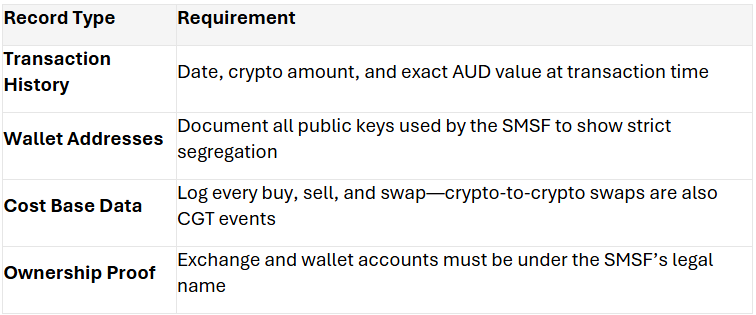
In 2026, the ATO’s systems run on real-time data matching. That means your SMSF crypto records must be immaculate.
Here’s what you need to maintain:
Pro Tip:
Use dedicated crypto tax software like Koinly or CryptoTaxCalculator with API integration.
Manual spreadsheets are now high-risk— and a red flag for auditors.
3. Compliance: Your Non-Stop Obligation
SMSF compliance is no longer once-a-year bookkeeping. It’s an everyday responsibility.
🔹 Update Your Investment Strategy
Your strategy must specifically address:
- Volatility — Crypto can swing 20% in a day. What’s your plan?
- Liquidity — Can you sell fast enough for pensions or withdrawals?
- Risk Allocation — Excessive crypto exposure is now an ATO audit trigger.
🔹 Asset Separation & Custody: Zero Tolerance Rule
The ATO’s #1 obsession is asset segregation.
What this means:
- No mixing personal and SMSF crypto
- No using personal exchange accounts
- No “temporary holding” funds in your own wallet
On custody, hardware wallets remain the gold standard—but in 2026, many SMSFs are adopting multi-sig wallets so that no single trustee can move funds alone.
4. Annual Audit & Valuation: Don’t Skip the Details
Every SMSF must undergo an independent audit by an ASIC-approved auditor.
Two Critical Requirements:
🔹 Fair Market Valuation (as of June 30)
- Crypto must be valued at true market price:
- Use trusted aggregators like CoinGecko or CoinMarketCap
- Keep timestamped screenshots or PDF reports
- Auditors want to see exact evidence.
🔹 Staking & DeFi Reporting
If your SMSF earns yield through:
- Staking
- Lending
- Liquidity pools
- Yield farming
All income is treated as ordinary income, taxed at 15%, and must be recorded separately from capital gains.
5. Governance: The Ultimate Trustee Responsibility
Crypto adds complexity — and regulators expect trustees to demonstrate robust governance.
That means:
- Documenting decisions
- Keeping minutes for every crypto-related action
- Reviewing wallet security regularly
- Demonstrating ongoing risk management
In the eyes of regulators, crypto isn’t a novelty — it’s a serious financial asset, and your SMSF governance must reflect that.
SMSFs that handle cryptocurrency well don’t just stay compliant — they gain access to one of the most dynamic investment landscapes of the decade.
But the message from regulators in 2026 is crystal clear:
If you want to play in the digital asset arena, you need real rules, real records, and real governance.
For More Information visit our Website
Reach out to us at biz@carisma-solutions.com.au
Connect with us on our WhatsApp.
Credits

Sundaram Shanmugam, Smart SMSF Team