

For many older Australians, the family home is more than just a place filled with cherished memories. It often represents their largest financial asset. As children move out and lifestyles evolve, maintaining a large property can become increasingly costly, time-consuming, and unnecessary.
While downsizing is commonly associated with simplifying life and reducing household expenses, it can also unlock a significant retirement planning opportunity. Through the Australian Government’s Downsizer Contribution scheme, eligible homeowners can transfer a portion of their home sale proceeds into superannuation, creating a powerful boost to retirement savings.
If you’re approaching retirement or already enjoying it, understanding how downsizer contributions work could help you maximize your financial security and create a more tax-effective retirement strategy.
What Is a Downsizer Contribution?
A downsizer contribution allows eligible Australians aged 55 years and older to contribute up to $300,000 from the proceeds of selling their family home directly into their superannuation fund.
For couples, the opportunity is even greater. If both partners meet the eligibility requirements, each person can contribute up to $300,000, enabling a combined contribution of $600,000 into super.
One of the most attractive features of this scheme is that it operates outside many of the standard superannuation contribution restrictions, making it a valuable planning tool for those looking to enhance their retirement nest egg.
Why Downsizer Contributions Are So Attractive
1. They Don’t Count Towards Standard Contribution Caps
Under normal circumstances, after-tax (non-concessional) contributions are subject to strict annual limits. However, downsizer contributions are exempt from these caps.
This means you can potentially contribute a substantial amount to super without impacting your ability to make other eligible contributions.
2. Total Super Balance Restrictions Don’t Apply
Many Australians are prevented from making additional non-concessional contributions once their total super balance exceeds certain thresholds.
Downsizer contributions are different.
Even individuals with substantial existing super balances can still take advantage of the downsizer rules, making it one of the few contribution strategies available regardless of current super holdings.
3. Access a Tax-Effective Investment Environment
Superannuation remains one of Australia’s most tax-efficient investment structures.
Key benefits include:
- Investment earnings in the accumulation phase are generally taxed at a maximum rate of 15%.
- Once moved into a retirement pension account (subject to limits and eligibility), earnings are often tax-free.
- Withdrawals for individuals aged 60 and over are generally tax-free.
By moving surplus home equity into super, retirees can potentially benefit from greater long-term wealth accumulation through tax-efficient investing.
4. You Don’t Have to Buy a Smaller Home
Despite the name, there is actually no requirement to purchase a smaller or less expensive property.
You may choose to:
- Buy a smaller home
- Purchase a larger property
- Move into a retirement village
- Rent instead of owning
- Relocate interstate
The key requirement is that the contribution comes from the sale proceeds of an eligible home.
Who Is Eligible?
To qualify for a downsizer contribution, you generally need to satisfy the following criteria:
✅ Age Requirement
You must be 55 years or older at the time the contribution is made.
✅ Ownership Requirement
You or your spouse must have owned the property for at least 10 years before the sale.
✅ Australian Property
The home must be located in Australia.
Properties such as:
- Houseboats
- Caravans
- Mobile homes
do not qualify.
✅ Main Residence Requirement
The property must qualify, at least partially, for the main residence Capital Gains Tax (CGT) exemption.
✅ One-Time Opportunity
You can generally make a downsizer contribution only once in your lifetime, making proper planning especially important.
Important Rules and Deadlines
Timing is critical when making a downsizer contribution.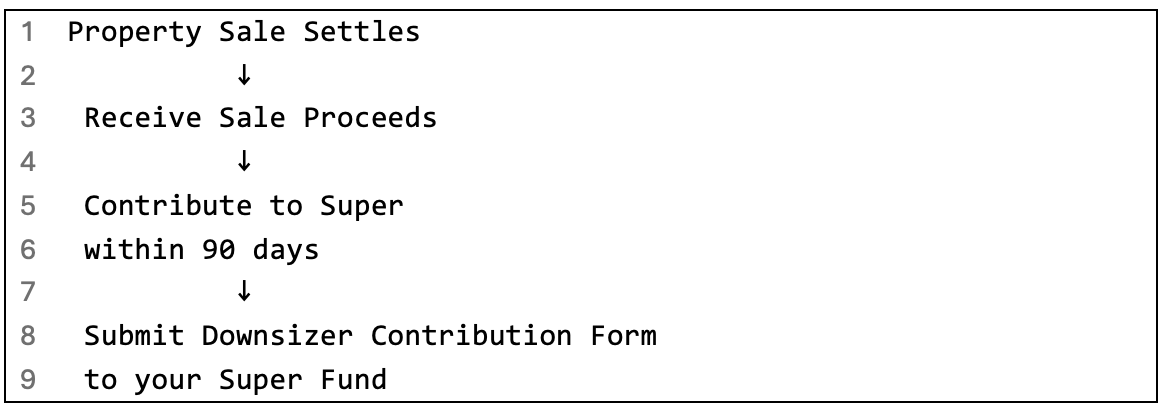
The 90-Day Rule
The downsizer contribution must be made within 90 days of receiving the sale proceeds from settlement.
Missing this deadline may result in the contribution failing to qualify under the downsizer rules.
Lodging the Required Form
Before, or at the time of making the contribution, you must submit the official Downsizer Contribution into Super Form to your superannuation fund.
Without the form, your contribution may be treated incorrectly and lose its downsizer status.
A Practical Example: John and Sarah
Let’s see how the strategy works in practice.
The Situation
John (62) and Sarah (60) purchased their family home 20 years ago for $400,000.
Recently, they sold the property for $1.5 million and moved into a coastal townhouse costing $900,000.
After the purchase, they had approximately $600,000 remaining.
The Strategy
Instead of keeping the surplus cash in a bank account:
- John contributes $300,000 to his super fund.
- Sarah contributes $300,000 to her super fund.
- Both contributions are made within 90 days of settlement.
The Outcome
- Total superannuation increases by $600,000.
- Contributions don’t count toward standard non-concessional caps.
- The funds can now benefit from the concessional tax environment of super.
- Future investment earnings may compound more efficiently over retirement.
For many couples, this strategy can significantly improve retirement income sustainability.
Factors to Consider Before Downsizing
While downsizer contributions offer compelling benefits, they should always be assessed within the context of your broader financial plan.
Impact on Age Pension Entitlements
Your principal place of residence is generally exempt from Centrelink asset testing.
However, money held in superannuation may be assessed under Centrelink’s income and asset tests.
As a result, moving wealth from your home into super could reduce or eliminate Age Pension eligibility for some retirees.
Transfer Balance Cap Considerations
Although downsizer contributions can be added to super without the usual contribution restrictions, the amount that can be transferred into a tax-free retirement pension account is still subject to the Transfer Balance Cap.
Exceeding applicable limits may mean some funds remain in the accumulation phase.
Transaction Costs
Downsizing is not free.
Potential expenses include:
- Real estate agent commissions
- Legal fees
- Conveyancing costs
- Stamp duty
- Building inspections
- Relocation and moving costs
These expenses should be carefully factored into any downsizing decision.
Making the Most of a Downsizer Strategy
A downsizer contribution can be particularly effective when combined with a broader retirement strategy, including:
- Pension commencement planning
- Estate planning
- Tax minimization strategies
- Investment portfolio restructuring
- Age Pension optimization
Seeking professional financial advice before selling your home can help ensure you maximize benefits while avoiding unintended consequences.
Final Thoughts
For many Australians, substantial wealth is tied up in the family home. Downsizer contributions provide a unique opportunity to unlock that equity and reposition it within one of Australia’s most tax-effective investment environments.
Whether your goal is to increase retirement income, enhance financial flexibility, fund travel, support family members, or simply enjoy greater peace of mind, downsizer contributions can be a powerful tool in your retirement planning toolkit.
The key is understanding the eligibility requirements, meeting the contribution deadlines, and carefully considering the broader implications for your financial future. With the right strategy, downsizing could do much more than simplify your lifestyle. It could significantly strengthen your retirement savings and help create the financial freedom you’ve worked hard to achieve.
For More Information visit our Website
Reach out to us at biz@carisma-solutions.com.au
Connect with us on our WhatsApp.
Credits

Sundaram Shanmugam, Smart SMSF Team