

When planning the transfer of superannuation benefits within a Self-Managed Super Fund (SMSF), one of the most common questions advisers and accountants encounter is:
Should a member rely on a Reversionary Pension or a Binding Death Benefit Nomination (BDBN)?
Both mechanisms play an important role in directing superannuation benefits after a member’s death. However, they operate differently and serve distinct strategic purposes. Misunderstanding their interaction, or assuming one automatically overrides the other, can result in unintended tax outcomes, beneficiary disputes, and costly legal complications.
This article examines the key differences between Reversionary Pensions and BDBNs, their interaction within an SMSF, and practical considerations for implementing an effective estate planning strategy.
Understanding the Difference: Continuation vs. Distribution
The fundamental distinction between these two strategies lies in their purpose.
Reversionary Pension
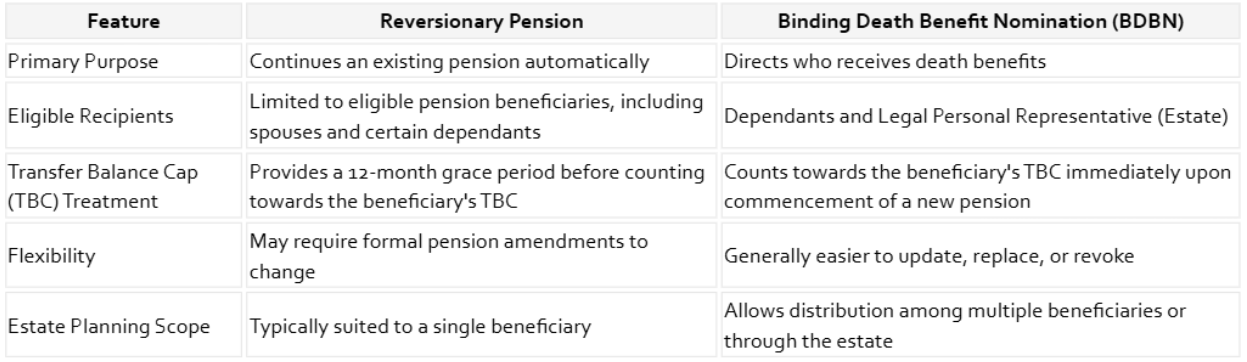
A Reversionary Pension is established within the pension documentation and provides that, upon the member’s death, the existing pension automatically continues to an eligible beneficiary, most commonly a surviving spouse.
Binding Death Benefit Nomination (BDBN)
A BDBN is a legally binding direction to the SMSF trustee specifying who is to receive the member’s death benefits. Benefits may be paid to eligible dependants or to the member’s Legal Personal Representative (LPR) for distribution through their estate.
Key Comparison
When Documents Conflict: Which One Takes Priority?
A common misconception is that either a Reversionary Pension or a BDBN automatically takes precedence over the other.
In practice, the SMSF Trust Deed is the determining authority.
Depending on the provisions within the deed:
- A Reversionary Pension may override a subsequent BDBN.
- A later BDBN may override an existing Reversionary Pension.
- If the deed is silent, trustee discretion and trust law principles may apply, creating uncertainty and potential disputes.
A Practical Example
Consider a member who establishes a Reversionary Pension in favour of their spouse and later signs a BDBN directing benefits to their estate. If the trust deed requires specific wording to revoke the reversionary nomination and that wording is omitted, the Reversionary Pension may still prevail despite the member’s later intentions.
This highlights the importance of ensuring all estate planning documents are reviewed together rather than in isolation.
Advantages of a Reversionary Pension
1. Transfer Balance Cap Flexibility
One of the most significant benefits is the 12-month deferral period before the death benefit pension is assessed against the recipient’s Transfer Balance Cap. This additional time can assist with:
- Pension restructuring
- Commutation strategies
- Managing excess Transfer Balance Cap issues
2. Potential Centrelink Benefits
For certain legacy pensions established before 1 January 2015, reversionary arrangements may assist in preserving favourable social security treatment.
3. Enhanced Asset Protection
Because benefits transfer directly to the nominated beneficiary rather than passing through the estate, assets may be less exposed to estate challenges or family provision claims.
Advantages of a BDBN
1. Greater Estate Planning Flexibility
A BDBN can direct benefits to:
- Dependants
- Multiple beneficiaries
- The Legal Personal Representative (Estate)
This can facilitate broader estate planning outcomes, including distribution through Testamentary Trusts.
2. Easier to Update
As personal and family circumstances evolve, BDBNs can generally be amended or replaced more easily than restructuring existing pension arrangements.
3. Ability to Split Benefits
Unlike a Reversionary Pension, which typically transfers to a single beneficiary, a BDBN can allocate benefits across multiple recipients in predetermined proportions.
The ATO’s Position
The Australian Taxation Office has clarified that a BDBN cannot, on its own, convert a non-reversionary pension into a reversionary pension.
For a pension to qualify as genuinely reversionary, the SMSF’s governing rules and pension documentation must provide for the reversion before the member’s death.
While a BDBN can instruct trustees to commence a death benefit pension for a beneficiary, this results in the creation of a new pension, rather than the continuation of the existing one. Consequently, the beneficiary does not receive the 12-month Transfer Balance Cap concession available under a genuine Reversionary Pension.
Practical Checklist for SMSF Advisers and Accountants
To ensure an SMSF estate planning strategy is effective and legally enforceable, consider the following steps:
Review the SMSF Trust Deed
Confirm how the deed addresses:
- Death benefit payments
- Reversionary pensions
- BDBN validity requirements
- Priority rules between competing nominations
Examine Existing Pension Documentation
Verify whether current pensions were established as reversionary and ensure documentation aligns with fund records.
Identify Conflicts Across Documents
Review the member’s:
- Will
- BDBN
- Pension documentation
- Estate planning arrangements
All documents should support a consistent outcome.
Engage Specialist Legal Advice
Where strategies involve complex family structures, multiple beneficiaries, discretionary trusts, or potential disputes, legal review is essential. Accountants and advisers should avoid drafting custom trust deed provisions or death benefit clauses without appropriate legal expertise.
Conclusion
The question is not whether a Reversionary Pension is better than a BDBN, but which strategy best aligns with the client’s estate planning objectives.
A Reversionary Pension offers certainty, administrative simplicity, and valuable Transfer Balance Cap advantages, particularly for surviving spouses. A Binding Death Benefit Nomination provides greater flexibility, broader estate planning options, and easier adaptation to changing circumstances.
Ultimately, the most effective SMSF estate planning outcomes are achieved when the Trust Deed, pension documentation, BDBN, and Will work together as a coordinated strategy. Ensuring these documents are properly aligned can significantly reduce the risk of disputes, unintended outcomes, and compliance issues while delivering the result the client intended.
For More Information visit our Website
Reach out to us at biz@carisma-solutions.com.au
Connect with us on our WhatsApp.
Credits

Sundaram Shanmugam, Smart SMSF Team